Subversive Books – The B.P.C. Catalogue 2026

B.P.C. Books Catalogue

B.P.C. titles -eleven in all – published to date (2022-2025) as paperback and ebook, available on Amazon.

For readers who don’t use Amazon, most of our titles can be obtained as ebooks at 22,000 libraries around the world, courtesy of PublishDrive. Ebooks ISBNs  available for libraries are given below.

1839: The Chartist Insurrection and the Newport Rising, by David Black and Chris Ford, with an Introduction by John McDonnell M.P. (new edition of the book published by Unkant in 2012)

Amazon #paidaffiliate Go to Amazon page

ISBN-for libraries – : 9781919342597

In History Today, January 2022,  Katrina Navickas wrote:‘The year most likely to result in a revolutionary moment was 1839.’ David Black and Chris Ford’s book supports this view. First published in 2012 by the late Unkant Books, it is now back in print, both as a BPC paperback and ebook, revised and copy-edited.

From Reviews of the First Edition

Ben Watson’s blurb-on-the-back: ‘In retrieving the suppressed history of the Chartist Insurrection, David Black and Chris Ford have produced a revolutionary handbook.’

Dan La Botz, New Politics ‘Black and Ford have written a fast-paced, narrative history of the 1839 Insurrection, filled with thumbnail sketches of the Chartist movement’s major figures, descriptions of the most important Chartist organizations and their politics in brief, excerpts from contemporary speeches, and parliamentary debates, and wonderful descriptions of the movement’s rise, growth, and spread throughout Britain. All of this is based on the most masterful command of the sources: newspapers, parliamentary records, memoirs, private papers, and all of the secondary literature. They tell their story in the most straightforward way but at a breathtaking clip that contributes to the sense of the excitement of the movement and its culmination in the insurrection.’

Stephen Roberts, People’s Charter ‘I read this book in one sitting as I sheltered from the pouring rain at Bodnant Gardens in North Wales. Based on a wide range of secondary sources and easy to read, it provided a welcome way of spending a few hours whilst waiting for the weather to clear (it didn’t!). The authors tell the story of a year when they assert the conditions for a working class revolution existed… For the authors a hero of the Chartist story emerges… George Julian Harney. And rightly so: Harney should be a hero to us all.’

March 2025

The Phantasmagoria of Capital: A Short History of the Commodity, the Spectacle and its Discontents, by David Black

Amazon Page

Ebook  ISBN=for libraries: 9781919342573

WiseBooks Series 1 -5
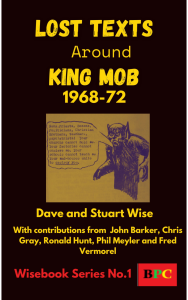
Lost Texts Around King Mob, by Dave and Stuart Wise. with contributions from John Barker, Chris Gray, Ronald Hunt, Phil Meyler and Fred Vermorel

Amazon Page 


Dialectical Butterflies: Ecocide, Extinction Rebellion, Green and Rewilding the Commons – an Illustrated Derive, by Dave and Stuart Wise.

Amazon Page

Ebook via Libraries: ISBN: 9781919342535
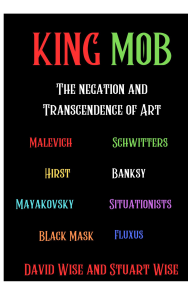
King Mob: the Negation and Transcendence of Art, by Dave and Stuart Wise

Amazon Page 

Ebook  ISBN=for libraries: 9781919342528

Lawton Browning, Fifth Estate, Vol. 60. No.1 Spring 2025 “New York City, 1967. Roaming the streets in debate on the merits of the then-peak vogue art movement, Abstract Expressionism, are Ben Morea, part of a local affinity group, Up Against the Wall Motherfucker, and David Wise and Anne Ryder of the English group of cultural subversives known as King Mob. It was perhaps on a matter of time before representatives of these two groups would cross paths. Both King Mob and the Motherfuckers (as they were colloquially known) emerged from the political tumult of 1967 under similar formative influences: a Marxist critique of capitalism, the international art movement known as Surrealism and, in the case of King Mob, as expelled members of the French critical theory group, the Situationist International.”

A Newcastle Dunciad: Memories of Music and Recuperation, by Dave and Stuart Wise

Amazon Page 

Ebook  ISBN=for libraries: 9781919342542

Building For Babylon: Construction, Collectives and Craic, by Dave and Stuart Wise

Amazon Page

Helen Macfarlane

Red Chartist: Complete Annotated Writings, and her Translation of the Communist Manifesto, by Helen Macfarlane

Amazon Page

Simon Webb, The Friend, Britain’s Quaker magazine (15 November, 2024) ‘It must occasionally happen that translators would rather not work on a particular passage. Perhaps such a thing happened to the Scottish Chartist Helen Macfarlane when she was translating The Communist Manifesto from its original German. She was a socialist with strong religious beliefs, whereas Karl Marx and Friedrich Engels seem to have regarded religion as a dead end.’ You can read it full on The Friend website
Red Republican: Complete Annotated Works of Helen Macfarlane and Translation of the Communist Manifesto
[Print Replica] Kindle Edition of the book published by Unkant Books in 2014


Red Antigone: The Life and World of Helen Macfarlane 1818-60, by David Black

Amazon Page

Ebook  ISBN=for libraries: 9781919342566

Psychedelic History
Psychedelic Tricksters: A True Secret History of LSD, by David Black

Amazon Page

Ebook  ISBN=for libraries: 6610001082307

“I recommend this book; it is more historically accurate than earlier books on this subject.” – Tim Scully, underground chemist of the 1960s who produced “Orange Sunshine” LSD.
LSD Underground: Operation Julie, the Microdot Gang and the Brotherhood of Eternal Love, by David Black

Amazon Page

Ebook  ISBN: for libraries: 9781919342580

Ellenore Clementine Kruger, Goodreads: Good background on old politics. Every now and then a chill blows in the wind and pushes us backwards in time and as i write this war is on the brink but certainly these old hippies were against war and represented an indigenous purity to be desired … a type of inner magic at peace with anarchy and due to the medical war on mortality there is just too much taboo… so this does have specific years and strains and gangs and names and locations which show a cool world but sadly the author mentioned David Solomon who he wasnt as big as other authors and i fear the biblical term of losing salt is like … pretty much the issue here: so yeah its a spiritual war but resting on material laurels like crystals and dots could definitely attract evil eye. *****


Continue reading “Subversive Books – The B.P.C. Catalogue 2026”
Preface to Psychedelic Tricksters: A True Secret History of LSD (New Edition) 

Psychedelic Tricksters: A True Secret History of LSD (New Edition) 

B.P.C. Publishing (London: 2025)

#sponsored AMAZON-LINK

“I recommend this book; it is more historically accurate than earlier books on this subject.” – Tim Scully, underground chemist of the 1960s who produced “Orange Sunshine” LSD.
Preface
Like atomic power and artificial intelligence, lysergic acid diethylamide (LSD) was discovered in the closing years of World War Two. Since then, atomic bombs and computers have been the constant source of fears that combined they might bring about the destruction of humanity. LSD has aroused similar fears. Albert Hoffman, the Swiss chemist who discovered its effects in 1943, likened the LSD trip to an ‘inner bomb’. He warned that, if improperly used and distributed, LSD might bring about more destruction than an atomic detonation. But it has also been argued that, if properly used and distributed, LSD use might actually change people’s consciousness for the better and help to prevent nuclear war.
Professor David Nutt, who sat on the British Labour government’s Advisory Committee on the Misuse of Drugs until he was sacked in 2009, argues that the study of psychedelics is essential for understanding the nature of consciousness itself: ‘This is core neuroscience. This is about humanity at its deepest level. It is fundamental to understanding ourselves. And the only way to study consciousness is to change it. Psychedelics change consciousness in a way that is unique, powerful, and perpetual – of course we have to study them’.
As is well known, in the 1950s and early ‘60s the US Central Intelligence Agency used LSD, in secret and illegal experiments, on unwitting subjects. The CIA did so according to Cold War logic: if the Russians could work out how to use LSD in bio-chemical warfare — or in ‘brain-washing’, as a ‘truth drug’, or even as a ‘Manchurian Candidate’ — then the USA needed to work it out first. In 1953, the CIA launched a top-secret ‘mind-control’ project, code-named MK-Ultra. The CIA’s assets in the US medical profession ‘officially’ labelled LSD as ‘psychosis- inducing drug’, only of use in psychiatric analysis and research.
Many CIA officers, contractors and assets however, became enthusiastic trippers themselves, in full knowledge that LSD could produce atrocious as well as enchanting hallucinations. Knowing the secrets of LSD, they thought of themselves as a kind of anti-communist spiritual elite who, unlike the US citizenry at large, were ‘in the know’. But by the end of the 1950s, with no sign of the Russians contaminating the water supply with LSD, there were plenty of signs in the United States that the psychedelic experience was escaping its captors.
Some of the researchers in American hospitals – who had little awareness that their work was being secretly sponsored by the CIA — realised that LSD had ‘spiritual’ implications, i.e. for developing an ‘integrative’ enlightened consciousness, conducive to visionary creativity.
These researchers stressed the importance of ‘set and setting’ in properly supervised LSD sessions. The English scholar, Aldous Huxley, who took his first LSD trip in 1955, related in his essay Heaven and Hell the hallucinogenic experience to the visionary works of William Blake: ‘Visionary experience is not the same as mystical experience. Mystical experience is beyond the realm of opposites. Visionary experience is still within that realm. Heaven entails hell, and “going to heaven” is no more liberation than
is the descent into horror. Heaven is merely a vantage point, from which the divine Ground can be more clearly seen than on the level of ordinary individualized existence’. ii Huxley, though an advocate for psychedelic drugs, wanted them strictly controlled. In contrast, Timothy Leary, who first took LSD in December 1961, became the ‘guru’ of psychedelia as LSD ‘escaped’ into the counter-culture of the 1960s. The ‘escape’ has been the subject of conspiracy theories which have been weaponised in today’s so-called Culture Wars.
According to one widely-held view, the entire psychedelic counter-culture of the 1960s was engineered by the CIA as part of a plot by some secret global elite bent on mass mind-control.
For elements of the Right, the psychedelic counter- culture undermined ‘traditional values’ such as patriarchy, nationalism and subservience to authority. On the Left, some see the 1960s hedonism of ‘Sex, Drugs and Rock’n’Roll’ as having been a distraction from politics. The theory, as it has spread, has thrown in extra villains for good measure: satanists, MI6, the psychiatrists of the Tavistock Institute, the Grateful Dead, and Theodor Adorno of the Frankfurt School of Critical Theory, etc, etc. In truth, the extent of the CIA’s involvement in the psychedelic counter-culture of the 1960s has always been difficult to determine; not least because Sidney Gottlieb, head of MK- Ultra, illegally destroyed the project’s operational files in 1973.
Nonetheless, some leading figures of the counter-culture, such as Timothy Leary, can hardly be discussed without reference to the CIA – not least because Leary himself had so much to say about it. In the present work, whilst I pay only scant attention to conspiracy theories, I make no apologies for investigating, where necessary, real conspiracies. The underground networks of acid producers and distributors on both sides of the Atlantic were described after their downfall in the nineteen-seventies in such terms as ‘Hippie Mafia’ or ‘Microdot Gang’: so out of their heads that they didn’t know any better; or were ‘only in it for the money’; or were tools of organised crime and/or state agencies.
In an earlier ebook I noted that nearly everyone involved – the psychedelic revolutionaries, the financiers, intelligence and anti-drugs agencies, CIA-sponsored scientists and researchers – operated to a greater or lesser extent outside of accepted standards of ‘legality’, or didn’t even recognise them; hence the title: Acid Outlaws: LSD, Counter-Culture and Counter-Revolution . But although the term ‘outlaw’ certainly fits many of people in this study, it doesn’t fit all of them by any means. Stephen Bentley, ex-undercover police officer and author of Undercover: Operation Julie – The Inside Story, takes exception to my use of the term ‘questionable legality’ regarding of some of the surveillance methods he and his colleagues used: ‘Questionable by who? Illegal – mostly not… Yes, I smoked a lot of hash… and did some cocaine. Technically, that was illegal. Tell me what I was supposed to do given I was undercover. I wasn’t Steve Bentley. I was ‘Steve Jackson’ – wild, carefree, giving all the impression I was a dealer. I’m now 72 years’ old. I don’t care for the historical revisionism applied to Operation Julie recently. It was a highly successful and unique police investigation carried out professionally under difficult circumstances’. On my reference to the ‘ham-acting of drunken undercover officers’, Bentley retorts: ‘Maybe you should try living a lie for the best part of a year; doing things alien to you; becoming a different person. Those who know will scoff at the thought of it being an act. It’s not. You become someone else – believe me’. The point is, I concede that although Stephen Bentley mixed with ‘acid outlaws’ and behaved like one when he was infiltrating them in north Wales in the 1970s, he certainly wasn’t one himself.
Steve Abrams – who inspired me twenty years ago to write about this subject in the first place – wasn’t an outlaw either. He is described in an obituary in Psychedelic Press quite accurately — as a ‘psychedelic trickster’. Many of the leading players who feature in this tale were certainly outlaws at various times but primarily they were tricksters. In Carl Gustav Jung’s definition of archetypes, the ‘Trickster’ surfaces in many stories in mythology, folklore and religion.
More generally, anthropologists studying indigenous cultures in various parts of the world identify the trickster with cunning crazy-acting animals such as the fox or coyote, shape-shifting gods such as Loki in Norse mythology and rustic pranksters in human form. In the literature of Greek antiquity, Prometheus, the son of a Titan, tricks the gods with his buffoonery and steals fire from heaven for the benefit of human kind, for which he is severely punished by Zeus.
As the historian of religion, Klaus-Peter Koepping, puts it:
‘In European consciousness Prometheus becomes the symbol for man’s never- ceasing, unremitting, and relentless struggle against fate, against the gods, unrepentingly defying the laws of the Olympians, though (and this again shows the continuing absurdity) never being successful in this endeavor, which, however, is necessary for the origin of civilized life (the ultimate paradox of rule breaking as a rule)’.
Like fire, psychedelic drugs can be dangerous as well as beneficial. In various ways the tricksters who feature in this book tended to believe that their antics were beneficial to humanity as well as themselves; and in most cases had to suffer the consequences of their actions. CIA MK-Ultra chief, Sidney Gottlieb, believed that that his immoral and dishonest actions were outweighed by his patriotism and dedication to science, but his reputation has been posthumously trashed (a biography by Stephen Kinzer calls him as ‘the CIA’s Poisoner- in-Chief’).
On the ‘other’ side, the reputation of Timothy Leary, who likewise believed he was acting as a patriot and saviour of civilisation, has shape-shifted from brilliant scientist to mystical guru, wanted criminal, wild-eyed revolutionary, renegade informer and finally self- aggrandising ‘showboater’. I sent a copy of the previous book to Tim Scully, a most significant actor in the events unfolded in this story. Scully is a meticulous researcher (he is compiling a history of LSD production in the US) and, as it turns out, a very reliable witness. Scully, born 1944, was in 1966 taken on as apprentice to the famous LSD chemist Owsley Stanley (AKA Bear Stanley). After Owsley withdrew from LSD production following a bust of his tableting facility in December 1967, Scully was determined to continue. After making LSD in successive laboratories in Denver, Scully began to work with fellow psychedelic chemist, Nick Sand (another trickster).
Their collaboration led to the establishment in November 1968 of a lab in Windsor, California, which ultimately produced well over a kilo (more than four million 300 μg doses) of very pure LSD that became known as Orange Sunshine. Scully, in writing to me, pointed to a number of errors in my writings regarding events in the USA. Generously, he provided me with a lot of very useful information: firstly, on how underground LSD production was organised in the United States in the 1960s; secondly, on the relations between the American LSD producers in the United States, their collaborators in Great Britain, and the ‘Brotherhood of Eternal Love’; and thirdly on the alleged CIA asset, Ronald Stark, whom Scully knew and did business with. With further research and fact- checking I realised that none of the previous books on the subject (including mine) have accurately covered these three issues. I hope – whilst making no claim to have written anything like a comprehensive or definitive history of the LSD underground – that this one does.

LSD in the Water Supply a ‘Myth’ Shock

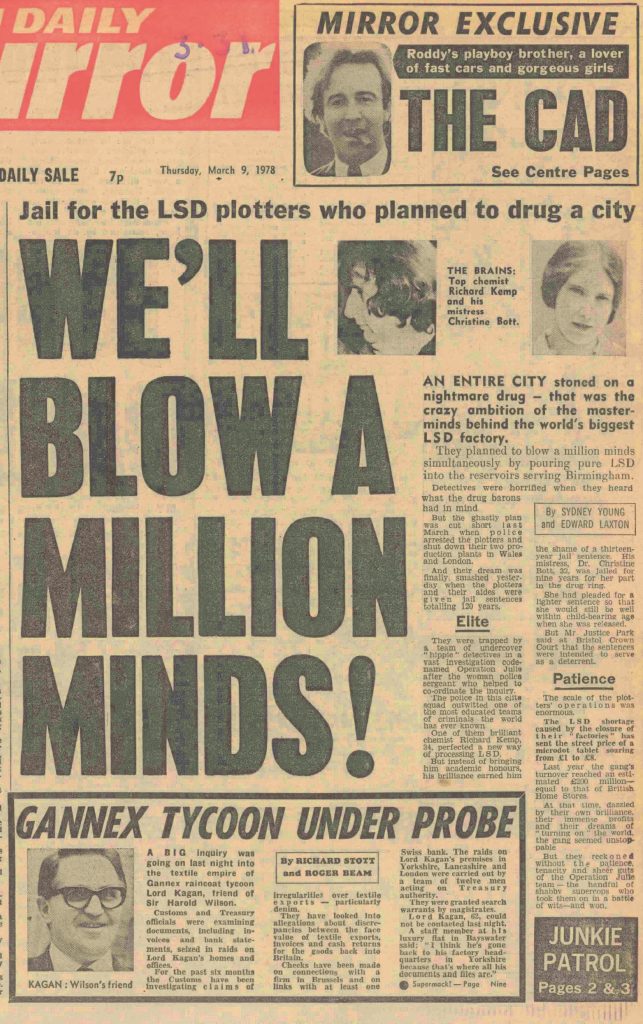
‘An entire city stoned on a nightmare drug – that was the crazy ambition of the masterminds behind the world’s biggest LSD factory.’

#LSDUnderground

The Daily Mirror, 1978: ‘An entire city stoned on a nightmare drug – that was the crazy ambition of the masterminds behind the world’s biggest LSD factory.’

The ‘masterminds’ were chemist Richard Kemp and his partner Dr Christine Bott – both jailed in the ‘Operation Julie’ trial days earlier. Kemp got 13 years. As for Bott, chemist Andy Munro, later commented, ‘Bott got nine years for making sandwiches. I got ten years for making acid’.

The Mirror continued:

‘Top chemist Richard Kemp and his mistress… planned to blow a million minds simultaneously by pouring pure LSD into the reservoirs serving Birmingham. Detectives were horrified when they heard what the drug barons had in mind.’

How the ‘acid in the water supply’ nonsense became front page news is one of the things explored in my new book, LSD UNDERGROUND: Operation Julie, the Microdot Gang and the Brotherhood of Eternal Love (available in paperback or ebook at Amazon).

Clue: The story, which was police-sourced, was written by Ed Laxton, the ghost writer for Operation Julie undercover officer Martyn Pritchard’s book, Busted!The Sensational Life-Story of an Undercover Hippie (1978).

The preface to LSD UNDERGROUND can be read on this site HERE