A Presentation at Whitechapel Gallery 12 October 2024 for the London Anarchist Bookfair. Plus an interview with the speaker, David Black: Q and A with Thomas Holland.
Good morning. My name is David Black and I run a shoestring publishing operation called BPC, which stands for the Barbarism of Pure Culture, inspired by the words of Theodor Adorno:
‘Whether art is abolished, perishes, or despairingly hangs on, it is not mandated that the content of past art perish. It could survive art in a society that hadfreed itself of the barbarism of its culture.’
BPC as a publisher is interested in historical events and persons whose legacy has been ignored, marginalised or distorted by historians, especially – as regards the case in hand – ‘cultural historians’.
BPC has published:
-
Red Antigone, the first biography of the Scottish Hegelian, Helen Macfarlane, 1818-60.
-
Red Chartist, Helen Macfarlane’s a collected works and translation of the Communist Manifesto for the Chartists in 1850.
-
1839: the Chartist insurrection and the Newport Rising.
-
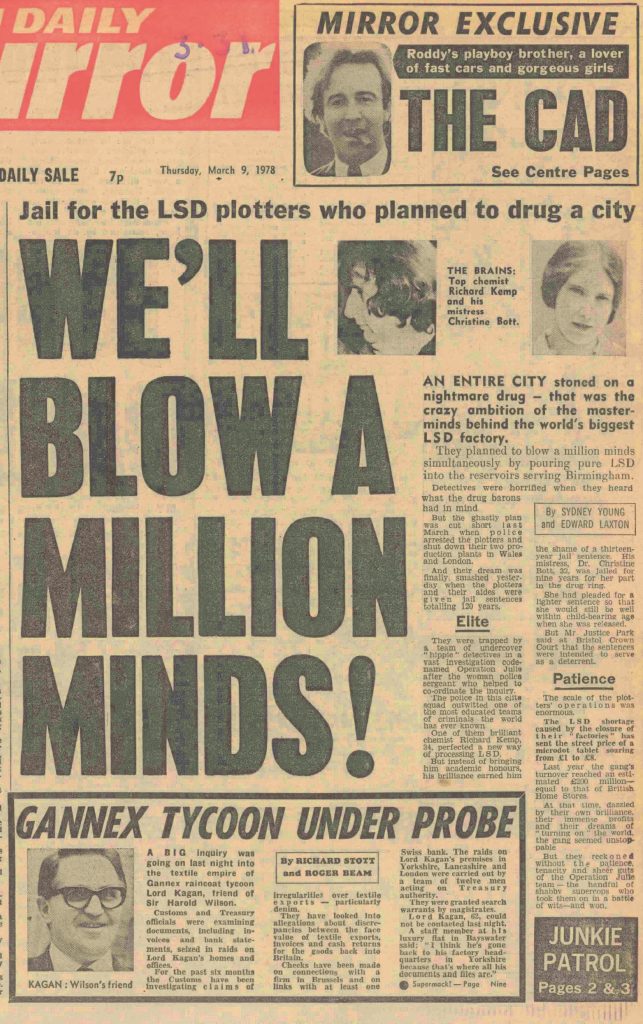
Psychedelic Tricksters: A True Secret History of LSD
-
LSD Underground: Operation Julie, the Microdot Gang and the Brotherhood of Eternal Love
-
Lost Texts Around King Mob
-
BPC WiseBooks Series
-
Dialectical Butterflies: Ecocide, Extinction Rebellion, Greenwash and Rewilding the Commons – an Illustrated Dérive.
-
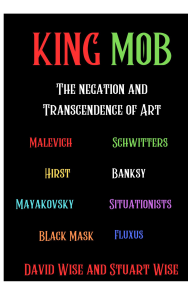
King Mob: The Negation and Transcendence of Art: Malevich, Schwitters, Hirst, Banksy, Mayakovsky, Situationists, Tatlin, Fluxus, Black Mask.
-
A Newcastle Dunciad 1966-2008: Recollections of a Musical and Artistic Avant Garde plus Bryan Ferry and the Newcastle Arts Scene
- Building For Babylon: Construction, Collectives and the Craic
Hegelian Dialectic
Twins David and Stuart Wise were born in Jesmond, Newcastle-upon-Tyne in 1943. Stuart died in 2021.
In the mid-1960s, as students at Newcastle University School of Art, they were associated with what they later called ‘the often confusedly anti-art magazine’, Icteric. It was at this time that Wises got hold of a volume of Hegel’s Lectures on Aesthetics. The influence of Hegel, who Karl Marx called that ‘mighty thinker’ he was a lifelong ‘disciple’ of, stayed with the Wises. And that’s where I’ll start, with my own ideas on why it might have impressed them as much as they say it did. More recently the Wises, always open to new ideas, have praised Anselm Jappe’s book, Guy Debord, (1999) which says ‘Debord’s theory is in essence the continuation of the work of Marx and Hegel and that its importance inheres for the most part precisely in this fact.’
In ‘essence’, so-to-speak, Hegel, post-French Revolution, argued that in bourgeois civil society the abstract principles of law and economics negate the organic unity of life. German Romanticism of the late-18th century saw the the art of Greek Antiquity as representing the unity of subject and object. But such organic unity had become impossible for a society in which, as Hegel saw it, the ‘lower world’ of economic nature promoted a ‘bestial contempt for all higher values’, tossed all sense of the divine into the world of ‘superstition’ and ‘entertainment’, and reduced the temple to ‘logs and stones’ and ‘the sacred grove to mere timber’.
What then was left for art? Hegel said that ‘as regards its highest vocation, art is and remains for us something past. For us it has lost its genuine truth and vitality; it has been displaced into the realm of ideas…’ Hegel did not doubt that works of art would continue to be produced and that artists would strive for perfection with new imaginative techniques. We are, after all, a species of story tellers, scibblers and makers of sounds.
However, what is aroused in us by art beyond immediate enjoyment is ‘the judgment that submits the content and medium of representation of art to reflective consideration.’ Think of Andy Warhol’s Brillo Box (as interpreted by Arthur Danto), made in his New York ‘Factory’ in 1964; only curated as a work of art — as opposed to just a box made in the Brillo factory — because of the art critics’ ‘reflective consideration’.
Black Mask
The purported aim of the Wises’ Icteric magazine in 1966 was the ‘fusion’ of ‘art and life’. It was mainly the brainchild of Ronald Hunt of the Department of Fine Art at Newcastle University, who had been appointed as librarian courtesy of lecturer and pop artist, Richard Hamilton. Hunt was familiar with the more marginal publications of the international art scene. It was he who first acquainted future Situationist member Donald Nicholson-Smith with the theoretical journals of the French Situationists. Hunt also learned of the activities of the Black Mask group in New York, such as their intervention at a meeting in a plush art gallery shouting, ‘burn the museums baby’, ‘art is dead’, ‘Museum closed’ etc. Dave Wise recalls:
‘Soon letters were sent out to New York and we got replies immediately: “brothers/sisters come and join us”! So two of us (Dave Wise and Anne Ryder) went from Newcastle to New York via London, and in the summer of 1967 engaged in some of the activities of Black Mask…
Dave recalls handing out anti-police leaflets with Anne Ryder at the entrance to a Black Power meeting on Lower East Side:
‘With my heart in my mouth I started handing out the Captain Fink leaflet together with other Black Mask stuff. Suddenly two cops jumped me, one thrusting a gun in my ribs whilst the other shoved the barrel of his gun against my forehead. They seized what I was carrying and slyly pilfered personal belongings though they stopped short of doing anything else. At the same moment another cop sidled up to Anne, who was wearing a mini-skirt, (English mini-skirts were still much shorter than their American counterparts) kissing her full on the lips… Ben Morea came running up just as the cops were moving on. He shook his head and said; ‘Dave, you shouldn’t have let them take the leaflets!’ It was then the difference between Newcastle and New York really struck home.
Ben Morea gave them the personal addresses and telephone numbers of Situationist sympathisers who resided in London. We duly contacted on them on our return to England.
The Construction of Situations
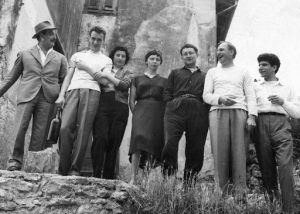 The Situationist International was founded in July 1957, at a conference in Cosio d’Arroscia, Italy by Guy Debord and Michèle Bernstein of the Paris-based Letterist International; painter Guiseppe Pinot-Gallizio and fellow Italians, Walter Olmo, music composer, and Piero Simondo and Elena Verrone of the International Movement for an Imaginist Bauhaus. Two other painters attended: Ralph Rumney from England; and Asger Jorn from Denmark.
Debord argued in his Report on the Construction of Situations that ‘the problems of cultural creation can now be solved only in conjunction with a new advance in world revolution.’ In order to combat the passive consumption he saw defining spectacular culture, Debord called for the international to organize collectively towards utilizing all of the means of revolutionizing everyday life, ‘even artistic ones.’
‘We need to construct new ambiances that will be both the products and the instruments of new forms of behaviour. To do this, we must from the beginning make practical use of the everyday processes and cultural forms that now exist, while refusing to acknowledge any inherent value they may claim to have… We should not simply refuse modern culture; we must seize it in order to negate it. No one can claim to be a revolutionary intellectual who does not recognize the cultural revolution we are now facing… What ultimately determines whether or not someone is a bourgeois intellectual is neither his social origin nor his knowledge of a culture (such knowledge may be the basis for a critique of that culture or for some creative work within it), but his role in the production of the historically bourgeois forms of culture. Authors of revolutionary political opinions who find themselves praised by bourgeois literary critics should ask themselves what they’ve done wrong.’
In the world theorized as the ‘Society of the Spectacle-Commodity’, Debord argued that art could no longer be justified as a ‘superior activity’ or as an honorable ‘activity of compensation.’ In the new conditions of the culture industry only ‘extremist innovation’ was ‘historically justified’. The ‘literary and artistic heritage of humanity’ could however, still be used for ‘partisan propaganda’ because its artifacts could be deflected or ‘détourned’ from their ‘intended’ purposes.
The Situationist concept of Unitary Urbanism sought to transform existing buildings and whole neighbourhoods into places for play and enjoyment – rather than what they have now become, deserts of dystopian high rise atrocities inspired by the finest postmodernist educations (don’t look up) and gentrified hubs of alienation now imposed by the developers (welcome to Whitechapel).
On 22 March 1968, students occupied the administration block at Nanterre University, leading to weeks of protests and the closure of the University for two days. The closure spread the protests to the Latin Quarter and the Sorbonne, which was also occupied. In the course of three days in occupation of the Sorbonne, the Situationists sent telegrams to every factory and union they could think of. As confrontations with the Paris police soon developed into large-scale street fighting, on May 11 the unions called for a general strike on the May 13. When, on May 14, workers at the Sud-Aviation plant in Nantes occupied the plant, supporters of the Enragés and the Situationists in Paris formed the Council for Maintaining the Occupations (C.M.D.O.). With its aim to promote autonomous “councilism,” the C.D.M.O. organized the printing of large numbers of pamphlets, such as For the Power of the Workers’ Councils, and posters, many of which were printed by workers at occupied print shops. Naturally, not being vanguardists, they didn’t credit these artefacts as the work of the Situationists, but they did the work anyway, and the rest, so to speak, is history.
Heatwave, the Situationist International and King Mob
As I said rearlier, in 1967, having heard of the Situationists in New York, Ben Morea gave Dave Wise and Ann Ryder the addresses and telephone numbers of Situationist sympathisers in London. They were the people around the magazine Heatwave. Four of them formed the English section of the Situationist International.
Let’s look at who they were (in some cases still are)
-
TJ Clark, who is today one the world’s leading art critics/historians.
-
Donald Nicholson-Smith, renowned translator of French literature.
-
Charles Radcliffe, who after the politics didn’t work out teamed up with Howard Marks and later was busted when customs in Anglesey seized a boat smuggling a vast quantity of hash, which meant Radcliffe spent much of the 1980s in prison. I recommend his autobiography, Don’t Start Me Talkin, which slags off my early efforts to tell the ‘secret history’ of LSD – and he was right, as I told him shortly before he died.
-
Chris Gray (1942-2009) edited, in 1974m Leaving the 20th Century, the first collection of Situationist writings in English. This was in collaboration with Jamie Reid, who in turn collaborated with Malcolm McLaren’s Great Rock’n’Roll Swindle, i.e. the Sex Pistols. Gray, after a stint with the Orange People sect in India, wrote The Acid Diaries: A Psychonaut’s Guide to the History and Use of LSD (2010).
That’s what became of them, but what drew them towards the SI in the first place was involvement in 1966, with Heatwave, the first magazine to put the new revolt of youth into some kind of perspective, with specific reference to Mods and Rockers, Beats, Dutch Provos and the like by Gray and Radcliffe; affirming their vandalistic acts of destruction as something which could have real future consequences. Bernard Marszalek, and Penelope and Franklin Rosemont sent reports on workers’ struggles in Chicago. There were numerous article on Dadaism, one on Unitary Urbanism by Attila Kotanyi and Raoul Vaneigem of the SI.
Initially, what resulted was a ‘meeting – if you like – between north and south’: between the Wise twins and friends, and the English section of the Situationists. In this new grouping the ideas of the Situationists and their predecessors were discussed in depth. For a year plans were made and collaborators sought out; things seemed promising. Then after SI member Raoul Vaneigem report to Guy Debord on a trip he made to New York in late-1967, the SI expelled the English Section.
The Wises explain that
‘Principally, Vaneigem objected to Alan Hoffman, a kind of mystical but political acidhead who’d started to show an interest in Black Mask… Also, Ben had a serious liver complaint and he couldn’t touch alcohol, thus acid went down very nicely… Ben was inevitably very upset… and started raving on in letters about the man-of-letters disposition Vaneigem put across, accusing him of not knowing anything about those at the bottom of the pile and street life in general. This created quite a dilemma in London as Chris Gray and Don N Smith in particular wanted to keep all the newfound friendships here alive and kicking. Knowing our friendliness with Ben Morea, they didn’t want to cause too many upsets before things could really kick in in terms of doing something together. Presumably because of their prevarication, they were excluded from the Situationists and the rest, so to speak [again], is history… Out of this lacunae and initial disorientation followed by a kind of re-think, King Mob developed.’
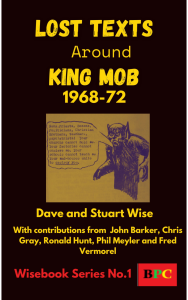
The BPC book, Lost Texts around King Mob features some of the writings of this milieu:
-
Ronald Hunt, art historian, The Arts in Our Time: A Working Definition; The Great Communications Breakdown, (1968)
-
John Barker, Art+Politics = Revolution in1968, which he wrote just before he became an Angry Brigade urban guerrilla.
-
Fred Vermorel, music writer who collaborated with Malcolm McClaren in formulating Punk Rock.
-
Chris Gray and Dave Wise, Balls! – a spoof sociological analysis of radicalism in Notting Hill.
-
Phil Meyler, Dublin associate of King Mob, publisher of Gurriers magazine (1968) and Notes from the Survivors of the Late King Red (1972); later chronicler of the Revolution in Portugal..
As regards King Mob practice:
‘Bit by bit we hoped through weaving in and out that we’d begin to encounter the forces which could materially realise the dreamt-of real potlatch of destruction as daily we contributed our small offerings to the process of furthering decomposition. Some of us almost on a daily basis kept gate-crashing the offices of the burgeoning underground press slagging them off for their lack of any theoretical grasp as well as their failure to get involved in any form of cutting-edge direct action. It was also hardly surprising that we tried to turn ritualised demonstrations into orgies of generalised destruction. On March the 17th, 1968 we started to turn over cars in Oxford St, getting quickly pushed aside rather heavily by demo stewards. Obviously we were nervous anyway about provoking such a break in England’s recent tradition of peaceful protest and thus connecting again with its distant but deep riotous past! By October of the same year such assaults had become easier to carry out (in the meantime, insurgents had quite magnificently smashed up a lot of cars in France) and we were a lot less fearful as we contributed to violent disorder, smashing showroom windows and trashing the regalia of the rich near the Hilton Hotel in Hyde Park as well as giving many a camera a good seeing to when those stupid idiots within our own ranks of protestors started clicking shutters. (The latter tactic seems much in need of revival when nowadays there are often more cameras than demonstrators on demonstrations).’
Of course it’s gone beyond that now; and indeed, rioting isn’t what it used to be. Consider the fate of the rioters up north this past August; we despise their bullying violence and pity them for falling for social media lies promoted by the fash; but the really sad fact is that they didn’t twig that they were carrying enough damning information on their cell phones to get themselves and their mates banged up by the hundreds in His Majesty’s hellholes.
In fact, the question now is to what extent real direct action has now, short of actual insurrection, become gaol bait for activists, now the reality of surveillance capitalism is beginning to kick in. The recent mass assassinations by Israel demonstrates to the world the sinister and deadly capabilities of coordinated surveillance technology that only comes to light when it is used.
As Guy Debord put it back in 1988, reflecting on new developments in the Spectacle:
‘A GENERAL working rule of the integrated spectacle… is that… everything which can be done, must be done… New machinery everywhere becomes the goal and the driving force of the system… continual technological innovation. This law must also thus apply to the secret services which safeguard domination. When an instrument has been perfected it must be used, and its use will reinforce the very conditions that favour this use. Thus it is that emergency procedures become standard procedures.’
How ‘Integrated’ can the Spectacle get?
To conclude…
As the Wises put it:
‘It could be said that King Mob had created an opening out of nothing in these islands and that is something that adds up to la gloire! Aggressive tactics had split something asunder as basically we were absolute beginners without any immediate reference points to hand. It’s like as though we were forced into the quasi-terrorist address against a back drop of quite terrifying incomprehension. Hardly surprising therefore that it was followed by direct action terrorism in the form of the Angry Brigade even though both were heading clean up the wall. By 1972, we realised we had nothing to fall back onto. Nobody would possibly publish anything we’d done or would even propose to do so.’
After the Tate Modern acquired the archive of King Mob in 2008, Hari Kunzru wrote apiece for the Tate website, entitled condescendingly ‘The Gang who Really shouldn’t be here’, in which he protested:
‘But these posters and magazines are just detritus, the record of past struggles. In the present day, the real action is elsewhere.’
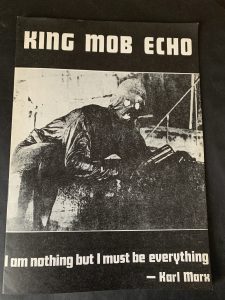
Whatever ‘real action’ consists of, and wherever the ‘elsewhere’ might be, are best left to Kunzru to explain. As for ‘detritus’ of ‘past struggles’, perhaps the detritus has more claim to relevance than what is today claimed in the ‘art world’ (and politics) to be ‘substantial’ (the opposite of detritus is ‘substance’); and perhaps past struggles have more to teach us than present-day capitulations to capital and its culture industry. In the age of culture wars, real or imagined, I recall an old King Mob Echo cover which quotes Antonin Artaud: ‘Question: What is Culture? Answer: Shit’. A proposition in the true Hegelian sense, worthy of discussion as to its validity, now more than ever.
***
Last year (12 October(2024) Thomas Holland (not to be confused with the vampire novelist) attended my presentation at the Whitechapel Gallery for the London Anarchist Bookfair. Thomas suggested he publish the text of my talk along with a Q and A. He put out a nicely illustrated pamphlet entitled The Barbarism of Pure Culture, David Black on King Mob and the Situationist International. Thomas’ output is not available anywhere online.
Interview
Q. Do you think that there are any signs or examples of a revolutionary culture in England?
A. In the course of 19th century ‘enlightened’ thinkers became concerned about the social consequences of capitalist industrialisation. Matthew Arnold, in Anarchy and Culture, railed against ‘the great Philistine middle-class, the master force in our politics’. He believed that art, like religion, could transubstantiate the profane stuff of everyday life into eternal truth. Terry Eagleton says of Anarchy and Culture:
‘Culture, in the sense of the refined and civilised, was needed to buy off the other half of Matthew Arnold’s title, anarchy. Unless liberal values were disseminated to the masses, the masses might end up sabotaging liberal culture.’
That was the idea, and was fulfilled to some extent when the northern cities opened public libraries, art galleries and museums. But in the the course of the 19th century the ‘eternal truths’ of culture were interwoven with the Romantic mythologies of blood-and-soil nationalism. One of the proles who educated himself reading library books was Jack Hilton, author of Caliban Shrieks. He wrote of his pre-1914 school education:
‘What impartiality we got for history! Stories about little drummer boys’ valour, the minstrel boy and hearts of oak. The horrors of the Black Hole of Calcutta, the glory of Nelson and Drake’s game of tiddlywinks – or was it bowls? … What a fighting chance we were given to understand the happenings of world significance – it was not a dog’s chance. It worked out this way. 1st: Heaps of God; 2nd: England first – the world nowhere; 3rd: Blatant swagger; one good innocent honest Christian blue-eyed English schoolboy equalled twenty infidel Japs (Ju Jitsu being barred of course).’
As regards the the quote by Debord on ‘cultural creation’ and ‘revolution’ it’s important to stress that he wasn’t talking about ‘revolutionary culture’, as culture is an epiphenomenon of the capitalist superstructure and subject to the process of commodification. Debord wasn’t trying to create a counterculture so much as recognizing that culture was a creation of the Commodity Spectacle; hence ‘We should not simply refuse modern culture; we must seize it in order to negate it.’
Q. Do you think that there is a revolutionary consciousness in England in our current moment?
A. No, there isn’t, and you’d have to go back a long way to find it (I’ll come to that later).
Q, You mention the anti-art magazine ‘Icteric’, which the Wise twins were associated with. Was this the incubator for the British Situationist movement? Was it important in propagating Situationist ideas?
A. I’ll expand a bit on what I said in my talk. From 1961 to 1965 Dave and Stuart Wise are art students in Newcastle. After leaving the School of Art they found Icteric and publish articles about Dada and Surrealism. Ronald Hunt, the School of Art librarian, tells Donald Nicholson-Smith about this group in Paris called the Situationist International. Nicholson-Smith and his pal, T.J.Clark, contact the S.I. and become members. Meanwhile, Ronald Hunt tells the Wise twins about Ben Morea’s Black Mask group in New York. Dave Wise and Anne Ryder of Icteric go to New York. Morea tells them about their friends in London, Charlie Radcliffe and Chris Gray, who have been publishing Heatwave magazine and have joined the S.I. So, in 1967, there is a kind of international coalition forming which consists of the Icteric group from Newcastle, Black Mask in New York, the ex-Heatwave S.I. members in London and Phil Meyler who publishes Gurriers magazine in Dublin. All very promising but, as this ‘coalition’ isn’t ‘officially’ part of the S.I., Debord sends Vaneigem to New York to check out Black Mask/Motherfuckers. Vaneigem falls out with them, and the result is that the English comrades in the S.I. are expelled. Some of them co-found the King Mob Echo with the Geordies.
So, in answer to your questions: Was Icteric the incubator for the British Situationist movement? No.Was it important in propagating Situationist ideas? Yes.
Q. Could ‘Icteric’ or the ‘King Mob Echo’ exist today, do you think?
A. In the 1960s there was an arts school counterculture which Icteric came out of. The art schools would accept working class school leavers who had a few grades and could show their skills with paint or whatever. The art schools have been called ‘Schools of Rock’, which is accurate in that so many rock bands came out of them. It’s all different now of course. As regards accessibility to an art education, who can afford it? Not working class youth.
Could King Mob Echo exist today? Well, in the 1980s, Class War was certainly inspired by King Mob (as founder, Ian Bone, will confirm). And don’t forget that Class War had it’s own version of McClaren’s Great Rock’n’Roll Swindle in the form of Chumbawumba who, according to Steven Wells, were Leeds Class War, and were the only band in Britain whose Special Branch file was bigger than their record catalogue. Go ask Alice Nutter!
Q. Can Situationism be resurrected?
A. The Sits and their sympathisers would take serious umbrage at being referred to as any kind of ‘ism’. Debord dissolved the S.I. in 1972 because he recognised that, as the S.I.’s ideas had become so influential globally that there was a danger of the ideas being recuperated. The S.I., whilst approving in principle of revolutionaries organising in autonomous groups, did not want to become yet another political sect claiming to ‘represent’ the forces of revolution.
The Situ legacy persists. The famous slogan ‘Ne Travail, Jamais’ and various Situ ideas have been theorized by influential writers such as Moishe Postone, Robert Kurz, Anselm Jappe, Roswitha Scholz and Tom Bunyard. Unlike other Marxists, these ones reject ‘labour’ as a liberating force. Personally, as a disciple of Raya Dunayevskaya who, back in the 1940s, sussed the implications of ‘value’ and commodity fetishism for class struggle, I am sympathetic inasmuch as they stand for the ending of value-production and the self-abolition of the working class.
Q. In some ways it feels like Debord’s writings already established the argument that Mark Fisher later made with his ‘Slow cancellation of the future’ theory – that we cannot perceive or decipher our present moment, we are too illusioned. Debord wrote in a pre-internet time, Fisher was post…Do you think that the internet has helped or hindered our ability to recognise reality, and should we consider the internet a friend or foe?
A. Mark Fisher’s line about ‘Slow cancellation of the future’ repeats Debord’s pessimistic retrospective on the Spectacle in 1988. Fisher used Derrida’s pomo concept of hauntology for his cultural writings (especially on sci-fi). The internet is both friend and foe. 20 or 30 years ago some of the acid-addled techies were looking forward to an electronic utopia of global communication. Now it’s become (literally) a virtual war zone in which the mega-rich are winning. The disastrous comeback of Trump is (to use Gramsci’s term) a ‘morbid symptom’ of this.
Q. In your talk you ask (the rhetorical question), ‘How ‘Integrated’ can the Spectacle get?’ – I’m wondering what the answer is, it seems like an atmosphere of complete irreality pervades this country and Europe – can it get more ‘integrated’ do you think?
A. It’s becoming more integrated by the day. In a sense the future hasn’t been so much cancelled, as made a taboo subject of conversation. Starmer promises ‘Change’ (to what?) and ‘Strength and Stability’ (for who?).
Q. Also from your talk, I love the lines ‘Obviously we were nervous anyway about provoking such a break in England’s recent tradition of peaceful protest and thus connecting again with its distant but deep riotous past!’ and ‘rioting isn’t what it used to be.’ So much of our past is obscured from us, and we are instructed over and over again that it is bourgeois parliamentarianism that brought us the rights we have – do you think that people believe that our hierarchical society is inevitable and desirable?
A. Yes, but it wasn’t bourgeois parliamentarianism that brought us the rights we have, but people like Tom Paine and Mary Wollstonecraft and countless others who put their lives on the line and inspired millions – and still do.
Q. This year members of Extinction Rebellion received record prison sentences for peaceful protest, one person was prosecuted for simply joining a Zoom conversation…how important is civil disobedience in fighting capital?
A. I think civil disobedience is crucial in fighting capital. But I think if you are going to risk getting incarcerated it should be for doing something effective that will merit public support. Disrupting the motorway with the result that hospital patients to miss their treatments isn’t going to do either. I also think that throwing soup at the glass frames of paintings and red flour paste that looks like paint at walls is bullshit: a case of activists pretending to be vandals, and the media pretending to be outraged. The problem isn’t that people don’t know or care about environmental destruction; it’s more like they don’t know what to do about it. I don’t think Roger Hallam knows either, but I don’t think he and his friends deserve being locked up in the shitty, rat-infested prison system. But who should be?
Q. You have written about Chartism, and your publishing house, The Barbarism of Pure Culture has published books on the Chartists. What do you think the Chartists can teach the Left today?
A. One of myths about ‘progress’ is that radicals are cleverer and morally superior to those of the past. In researching the formation and early history of the Chartists for our book, 1839, Chris Ford and I found this was not the case. The roots of working class radicalism include the campaign against slavery. To pass the 1832 Parliamentary Reform Bill the Liberals mobilised the workers and subsequently betrayed and excluded them. The radical workers fell back on their own resources, and what amazed us was how creative, imaginative and brave they were. For example, they did not have access to the vast reading resources we have now. Feargus O’Connor’s weekly paper, the Northern Star, gained a very large readership and became an organisational tool of the radicals. The paper would be read out loud in clubs and taverns for the benefit of the illiterate. In 1839, we argue, there was a real prospect of armed revolution that has never been repeated.
Q. It was interesting hearing about the origins of British Situationism in Newcastle – meanwhile, the Anarchist book fair took part in London, do you think that counterculture is too London-centric these days? Or is that a misconception?
A. Anarchists up north can and do organise their own book fairs. But London-centricity is real generally. As a chippie northerner I’ve speculated that one day there will be an imperial city (Londonium 2.0) with border controls on the M25.#



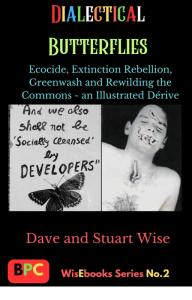 Dialectical Butterflies: Ecocide, Extinction Rebellion, Green and Rewilding the Commons – an Illustrated Derive, by Dave and Stuart Wise.
 A Newcastle Dunciad: Memories of Music and Recuperation, by Dave and Stuart Wise
 Building For Babylon: Construction, Collectives and Craic, by Dave and Stuart Wise
 Red Chartist: Complete Annotated Writings, and her Translation of the Communist Manifesto, by Helen Macfarlane
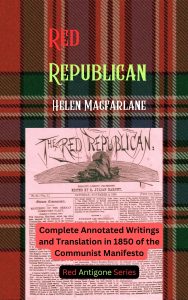 Red Republican: Complete Annotated Works of Helen Macfarlane and Translation of the Communist Manifesto
 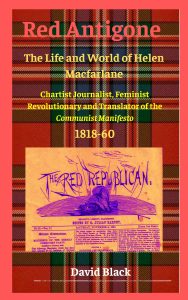 Red Antigone: The Life and World of Helen Macfarlane 1818-60, by David Black
 Psychedelic Tricksters: A True Secret History of LSD, by David Black
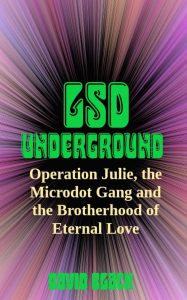 LSD Underground: Operation Julie, the Microdot Gang and the Brotherhood of Eternal Love, by David Black